Serious games for corporate training: what they are and when they work
What serious games are, how they differ from gamification and e-learning, and when they really work in corporate training. With a real example.
In short: a serious game is a game designed to teach or train skills, not just to entertain. In corporate training it works best when people need to practise procedures and decisions: they try realistic situations, make mistakes without consequences and learn from immediate feedback.
What is a serious game?
The term became known through Clark C. Abt’s book Serious Games, published in 1970, which proposed using games for education and training. The best-known example is as old as computing: flight simulators, where pilots train for situations that would be too risky to practise for real.
A corporate serious game does the same on a smaller scale. It can simulate a hotel reception, a sales conversation, a safety procedure or a customer complaint. The goal is not to win: it is to leave the game able to do something better than before.
Serious games, gamification and e-learning: the differences
The three terms are often confused. Here is how to tell them apart:
| What it is | Example | |
|---|---|---|
| E-learning | Digital learning content: videos, slides, quizzes | An online privacy course with a final test |
| Gamification | Game mechanics applied to an activity that is not a game | Points and badges for completing courses |
| Serious game | A real game, built to teach | A simulation where you run a hotel shift |
They are not alternatives: an effective programme often combines them.
When a serious game really works
A serious game shines when the skill is learned by doing. In particular:
- Multi-step procedures, where order matters: check-in, safety, order handling.
- Decisions under pressure, when people must choose quickly between options.
- Rare or risky situations that cannot be practised in real life: an emergency, a very angry customer.
- Soft skills such as communication, priorities and teamwork, trained through scenarios and consequences.
- Onboarding, to introduce newcomers to the company, its departments and its ways of working.
When the goal is only to pass on simple information, a clear document or a short video remains the more efficient choice. A good partner will tell you so.
How to design an effective serious game
- Observable goals. Not “know the procedure”, but “complete a check-in correctly, without missing mandatory steps”.
- Real scenarios. Built with the company’s in-house experts and real procedures, not generic examples.
- Immediate feedback. Every choice shows its consequence right away, so people understand why.
- Progressive difficulty. Start simple and add variables, as in any good game.
- Easy access. Join from a link or QR code, on phone, tablet or computer, with nothing to install.
- Data that helps training. Scores, recurring mistakes and times show where people need support.
An example: Grand Hotel Simulator
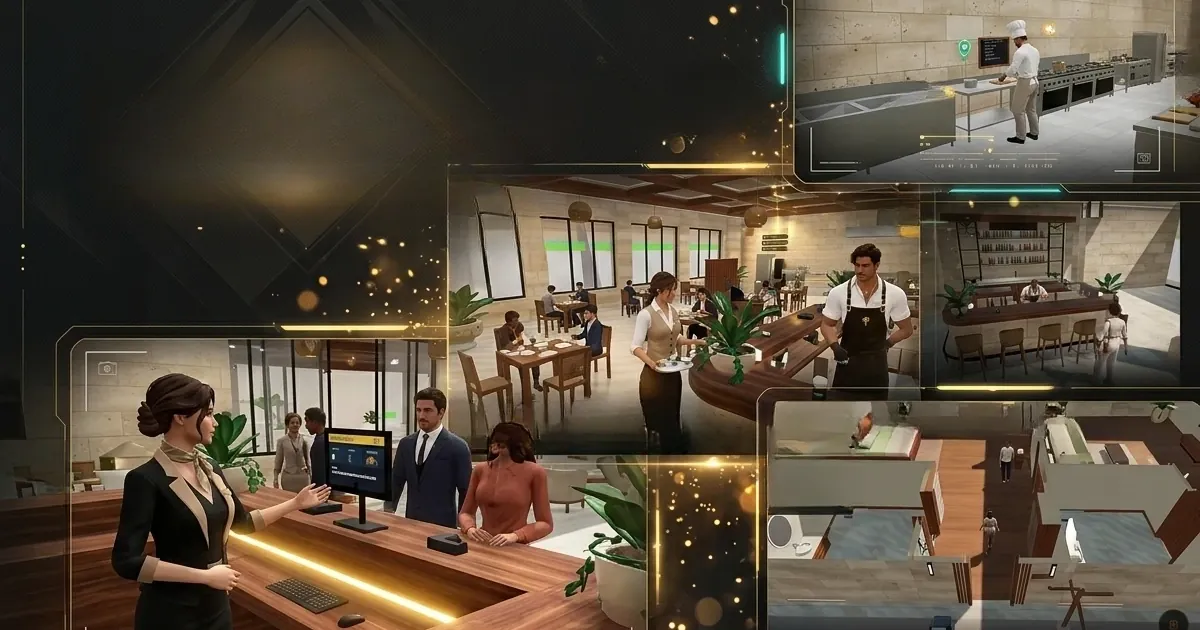
Grand Hotel Simulator, built by our creative director for hospitality and tourism schools, puts students in six roles: reception, restaurant, kitchen, bar, housekeeping and management. It is designed for people who may know neither the job nor video games: they join from a QR code in seconds and practise real procedures before making mistakes with a real guest. You can try it in our portfolio.
How to measure results
A serious game produces data that a traditional course cannot: how often someone repeated a scenario, where they go wrong most, how long they take, how they improve over time. Read together with the training manager, this data shows where to step in. It is good practice to collect it in aggregate form, in line with GDPR, and to agree with HR in advance which data is really needed.
Frequently asked questions
Does a serious game replace classroom training?
No, it complements it. It is especially useful for practising procedures and decisions, and it works alongside classroom sessions, e-learning and on-the-job coaching.
How long is a game session?
Usually a few minutes per scenario, so people can play during a break or on their phone. Several short scenarios work better than one long session.
Do people need to be gamers?
No, if the game is designed for everyone: simple controls, clear instructions and a first level that teaches how to play.
How much does a training serious game cost?
It depends on the number of scenarios, the roles involved and the languages. With an AI-accelerated method, timelines have shrunk considerably: a first prototype can be ready quickly, to test with a small group before rolling it out.
Want to turn a procedure or an onboarding path into a game? See our serious games or write to [email protected].

Play2Business designs and builds custom advergames, serious games and interactive experiences for companies and institutions.
About →